


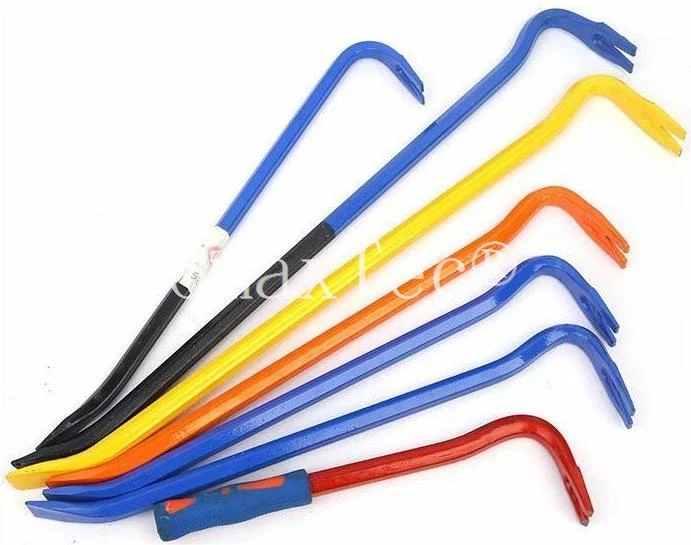


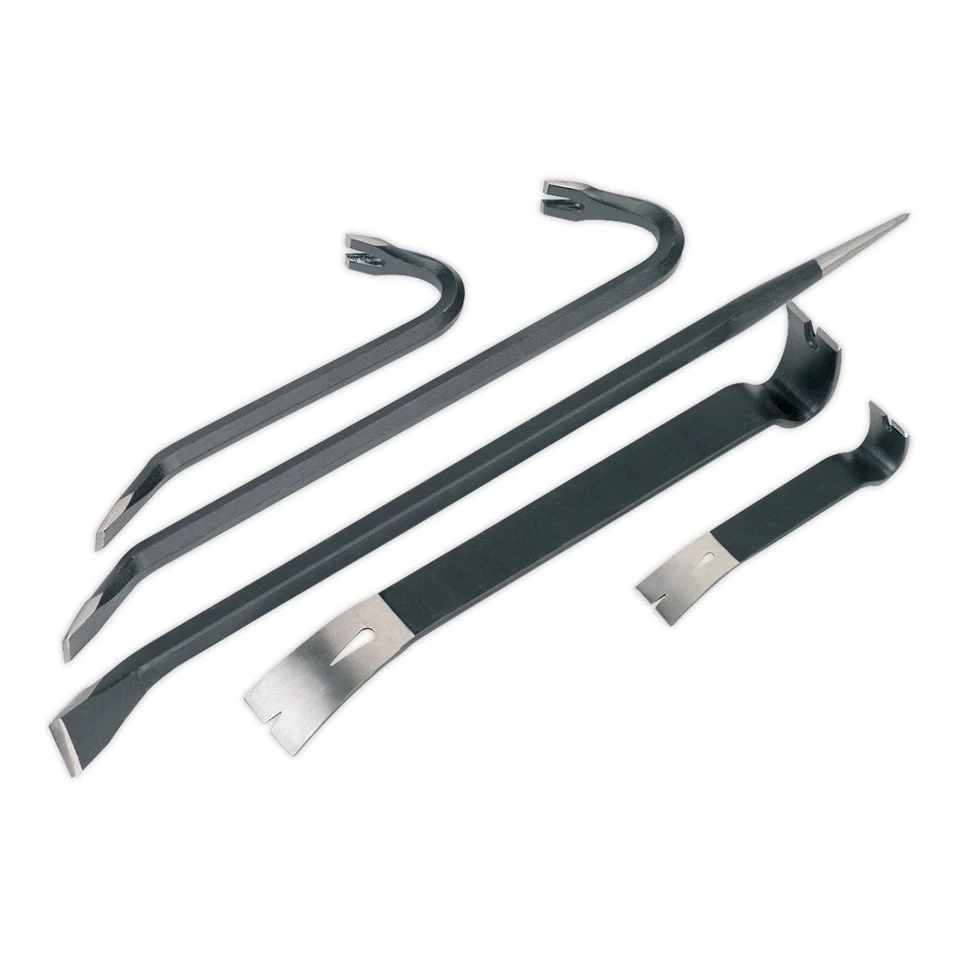

Wrecking bars, also known as crowbars, pry bars,, are fundamental tools in demolition, construction, and renovation. Their primary function is to exert immense leverage for prying apart materials, pulling nails, lifting heavy objects, and breaking through obstacles.
Product Specifications:
Material: Almost universally made from high-carbon steel (typically 1045-1095 grade) or alloy steel (like chrome-vanadium). This provides the necessary combination of immense strength to resist bending under heavy loads, toughness to withstand impact shocks (like hammering on the striking cap), and hardness to prevent the nail-pulling claw from deforming. Some variants may have vinyl or rubber grips for comfort.
Length: Ranges dramatically based on type and purpose. Common lengths are 12-24 inches (300-600mm) for tight spaces and lighter work, up to heavy-duty 36-60 inches (900-1500mm) for maximum leverage on major demolition tasks. Leverage increases significantly with length.
Head Design:
Striking Cap: A flat, hardened surface opposite the claw, designed to be struck repeatedly with a sledgehammer to drive the bar into materials or augment prying force.
Claw: The primary working end. A deeper, thicker claw with a more acute angle provides superior nail-pulling grip and strength.
Shaft Profile: Can be flat (common on pry bars), hexagonal/octagonal (provides anti-roll and better grip, common on wrecking bars), or round. Thickness and taper are critical for strength and preventing buckling.
Finish: Often a durable black oxide or painted finish to resist corrosion. The striking cap and claw are usually left uncoated hardened steel.
Common Types:
Flat Pry Bar / Wrecking Bar: The most common type. Features a long, flat or slightly curved shaft (hexagonal often), a curved claw (often around 30-45 degrees). Sizes range widely. Ideal for general prying, light demolition, pulling large nails, and lifting. The hex shaft prevents rolling.
Crowbar (Traditional): Characterized by a single, significant curve along its entire length, forming the leverage point and ending in two tapered, flattened ends (one often slightly forked for nails). Less common now than flat wrecking bars but excels in specific heavy prying/scraping tasks.
Pinch-Point Bar: Shorter and stubbier than a flat bar. Has a sharply bent, very narrow claw ("pinch point") designed specifically for extracting deeply embedded nails where a standard claw won't fit. Very tough construction.
Gooseneck Pry Bar: Features a distinct, high-angled "gooseneck" bend near the claw end. This design provides excellent clearance when prying up objects like floorboards or decking close to a surface, allowing the user to get leverage without damaging the surrounding material excessively.
Manufacturing Process:
Material Preparation: High-carbon or alloy steel billets are cut to approximate lengths.
Heating: Billets are heated in a furnace to a precise, high temperature (typically above 1000°C / 1832°F) until they become malleable ("forging heat").
Hot Forging: The red-hot billet is placed between powerful dies in a forging press or hammer to get required shapes.
Trimming & Punching: Excess flash (steel squeezed out between dies) is trimmed off.
Heat Treatment:
Hardening: The forged bar is reheated to a critical temperature and then rapidly quenched (cooled) in oil or water. This transforms the steel microstructure to martensite, making it very hard but brittle.
Tempering: The hardened bar is reheated to a lower, specific temperature (based on steel grade) and held, then cooled. This reduces brittleness while retaining much of the hardness, achieving the optimal balance of toughness and durability. The striking cap and claw are typically tempered to a slightly lower hardness than the shaft for maximum impact resistance.
Finishing:
Scale (oxide from heating) is removed via shot blasting or grinding.
The bar may be ground to smooth forging marks or sharpen claw edges slightly.
A protective finish (black oxide, paint, or lacquer) is applied to the shaft. The striking cap and claw working surfaces are usually left bare, hardened steel.
Vinyl or rubber grips are slid onto the shaft if specified.
Inspection & Packaging: Bars are inspected for dimensional accuracy, finish quality, and hardness. They are then packaged for shipment.
Hot Tags: wrecking bar pry bar, China wrecking bar pry bar manufacturers, suppliers, factory, Allen Keys Hex Keys, Cide Cutting Diagonal Cutting Plier, jumbo socket set, Long Nose Bent Nose Plier, Masonry Cold Chisel, Rigid Heavy Duty Pipe Wrench


