


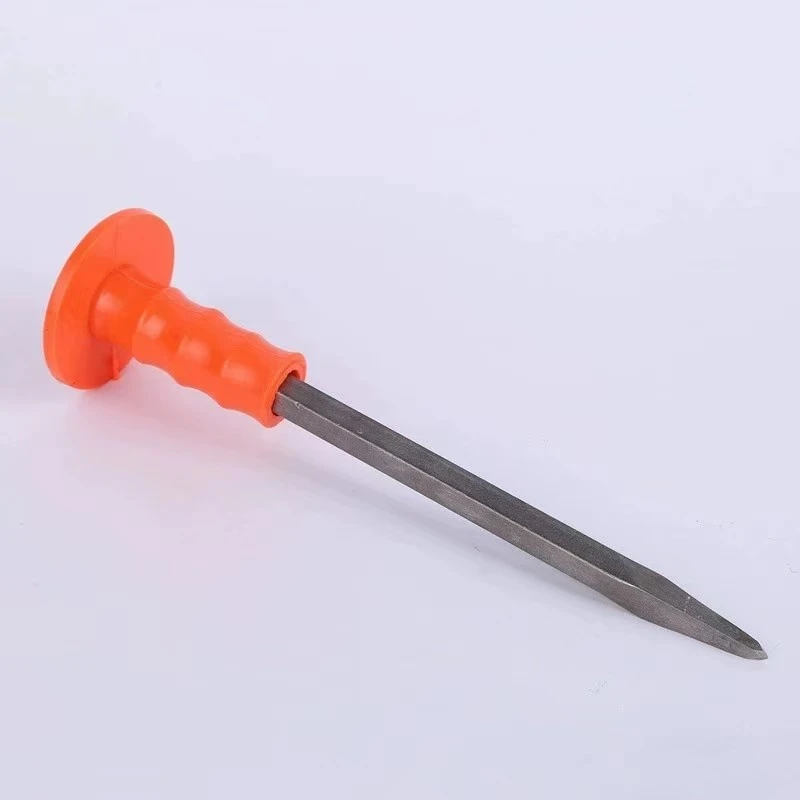


Masonry chisels are essential hand or power tools designed for the demanding tasks of cutting, shaping, trimming, and demolishing hard, brittle materials like stone, brick, concrete blocks, and cured concrete. Unlike woodworking chisels, they are built to withstand heavy impact and abrasion.
Product Specifications:
Material: Primarily made from high-carbon steel (C70/C80 or similar) or chromium-vanadium alloy steel (Cr-V). These alloys offer an optimal balance of hardness and toughness to resist chipping or shattering under hammer blows.
Dimensions:
Length: Varies from 150mm (6") to 350mm (14") commonly.
Width/Blade Size: range from 6mm (1/4") for fine work to 50mm (2") or wider for heavy demolition.
Thickness: range from ~12mm to 20mm+.
Common Types of Masonry Chisels:
Cold Chisel (Flat Chisel): The most basic type. Features a straight, flat cutting edge beveled on both sides. Used for general cutting, trimming, breaking small pieces, and light demolition. Widths vary.
Plugging Chisel (Point Chisel): Has a sharp, tapered point (often diamond-shaped cross-section). Primarily used for starting holes, removing mortar from joints (raking out), and precise breaking tasks like starting a line in concrete.
Brick Bolster : Wide-bladed (typically 75mm-100mm / 3"-4") with a straight, flat, beveled edge. Designed specifically for cleanly cutting bricks, blocks, and pavers with a single sharp blow. Often has a striking cap.
Manufacturing Process:
Material Selection & Cutting: High-carbon steel (C70/C80) or Cr-V alloy steel bars are cut to approximate lengths.
Forging (Traditional & Best Method): The primary shaping process. The cut steel bar is heated to a high forging temperature.
Using high-pressure mechanical or hydraulic hammers and shaped dies, the hot steel is struck repeatedly. This forges the metal, compressing its grain structure, creating the basic chisel shape (blade, taper, shank, striking end), and significantly increasing its strength and toughness.
Annealing (Optional but Beneficial): After forging, the chisel may be annealed (slowly cooled) to relieve internal stresses and soften the steel slightly for easier machining.
Machining (Grinding & Milling): The forged blank is precisely ground to final dimensions:
The blade profile is ground (straight, pointed, wide).
The striking end is shaped and smoothed.
Heat Treatment :
Hardening: The chisel is heated to a critical temperature (around 800°C / 1470°F for carbon steel), then rapidly quenched in oil, water, or polymer. This transforms the steel's structure to martensite, making it extremely hard but also brittle.
Tempering: To reduce brittleness and achieve the desired toughness, the hardened chisel is reheated to a lower, specific temperature (typically 200°C - 400°C / 400°F - 750°F), then cooled. This controlled process sets the final hardness (55-62 HRC). The tempering temperature directly determines the final hardness/toughness balance.
Surface Finishing : The Chisels are usually powder coated for rust prevention. In some cases they are just sand blasted.
Final Grinding & Sharpening: The cutting edge is precisely ground to a sharp edge at the specified bevel angle.
In the last the Chisels are fitted with Rubber / Plastic hand grips as per the customer's requirements.
Quality Control & Coating (Optional): Chisels are inspected for dimensions, hardness, straightness, and visual defects. A protective coating (often a light oil or black oxide) is usually applied to prevent rust.
Packaging: Chisels are packaged, often with safety warning Labels.
Hot Tags: masonry cold chisel, China masonry cold chisel manufacturers, suppliers, factory, Allen Keys Hex Keys, Cide Cutting Diagonal Cutting Plier, impact and socket set, Stoning Hammer, Swedish Pipe Wrench, Water Pump Plier


