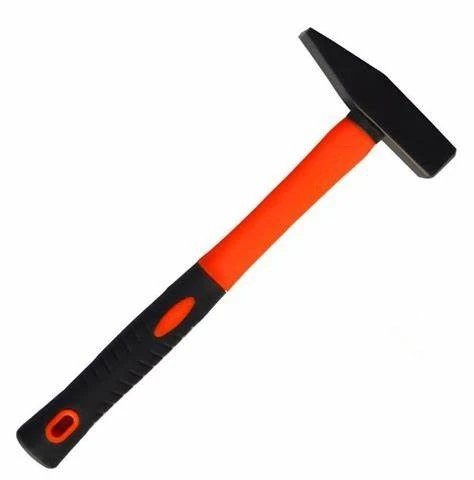
Machinist hammers, distinct from their carpentry cousins, are specialized hand tools designed for precision work in metalworking, machinery assembly, disassembly, layout, and fitting. They prioritize controlled impact, accuracy, and durability over brute force.
Product Specifications:
Head Weight: The core specification, measured in ounces (oz) or grams (g). Common weights range from 100g for delicate work up to 2000g
Head Material:
High Carbon Steel for rigidness & toughness
Brass, Bronze, Copper: Used for soft-face hammers to prevent marring finished surfaces.
Plastic (Nylon, Delrin), Rawhide: Softer alternatives for highly delicate surfaces.
Handle Material:
Wood: Traditional, excellent shock absorption, good strength.
Fiberglass: Very durable, excellent vibration dampening, weather-resistant.
Steel: Used for "engineer's" hammers; very durable but transmits more shock. Often fitted with vinyl or rubber grips.
Wedge & Adhesive (Wood): Traditional method, requires proper installation.
Molded/Epoxy Bonded (Fiberglass/Composite): Very secure, often considered the modern standard.
Press-Fit/Screw (Steel): Robust mechanical connection.
Finish: Often a protective coating like lacquer, paint, or clear coat on the handle, and sometimes a protective oil or black oxide finish on the steel head to prevent rust.
Balance: The feel and control during use are heavily influenced by the weight distribution between head and handle.
Common Types:
Standard Machinist Hammer: Square corss section head With one flat face end on head and other being wedge shaped face end.
Ball-Peen (Engineer's) Hammer:
Faces: One flat face for general striking (chisels, punches, rivets) and one rounded "peen" (ball-shaped) for riveting, peening metal (spreading or shaping), and rounding edges. Most common type.
Cross-Peen (Straight-Peen) Hammer:
Faces: One flat face and one wedge-shaped "peen" perpendicular to the handle. Primarily used in blacksmithing and some specific metal shaping/riveting tasks, less common than ball-peen for general machinist use.
Chipping Hammer: Smaller, lightweight hammers (often < 16oz) with sharp, chisel-like peens, used for removing slag or light chipping work.
Manufacturing Process:
Material Selection & Cutting: High-carbon or alloy steel bar stock is cut into precise blanks (cylinders or near-net shapes) for the hammer head.
Forging (Traditional Method): The heated blank is placed in dies within a forging press or hammer. Intense pressure shapes the hot steel into the rough form of the hammer head, including the peen shape and eye (hole for the handle). Forging aligns the grain structure for strength.
Machining (Modern/Precision Method): Blanks can be precisely machined using CNC lathes and milling machines to form the head shape, faces, peen, and eye. This offers high dimensional accuracy.
Eye Drilling/Broaching: The hole (eye) for the handle is precisely drilled and/or broached to the correct size and shape.
Heat Treatment:
Hardening: Heads are heated to a critical temperature (e.g., 1500-1600°F / 815-870°C for 1045 steel) and rapidly quenched (oil, water, polymer) to form hard martensite.
Tempering: Reheated to a lower temperature (e.g., 400-600°F / 200-315°C) to reduce brittleness, relieve stresses, and achieve the desired combination of toughness and hardness. Specific temperatures control the final Rockwell hardness.
Surface Finishing: Head is powder coated for rust prevention and Faces and peens are ground to precise flatness or smooth spherical contours.
Handles:
Wood: Shaped on lathes, sanded smooth.
Fiberglass/Composite:
Steel Pipe: Formed, often coated, fitted with grips.
Assembly: Handle is inserted into the head eye.
Wood: Secured with one or two hardened steel wedges driven perpendicularly, often supplemented with adhesive.
Fiberglass/Composite: Typically bonded securely with high-strength epoxy resin during insertion. A steel or composite wedge may also be used.
Steel: Usually a press-fit combined with a screw or rivet through the head into the handle.
Final Inspection & Testing: Faces checked for flatness/roundness, weight verified, hardness tested (often spot checks), balance assessed, and handle security rigorously tested. Visual inspection for defects.
Hot Tags: machinist hammer, China machinist hammer manufacturers, suppliers, factory, deep impact socket set, square drive socket, the best impact socket set, regular socket on impact wrench, blue point water pump pliers, impact lineman socket set