


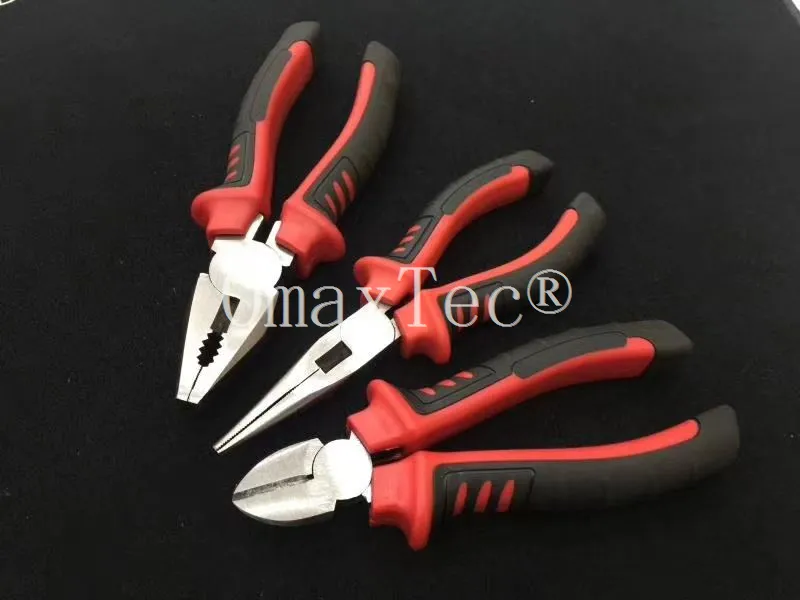


Side cutting pliers, universally recognized as diagonal cutters, or wire cutters, are designed primarily for cutting wire, cables, small fasteners, and other materials. Their defining characteristic is the cutting blades (jaws) set at an angle (diagonally) to the handle pivot point, concentrating force efficiently.
Product Specifications:
Cutting Capacity: The maximum diameter/type of wire the cutter can cleanly shear ranges from fine electronics (< 1mm) to heavy-duty electrical/mechanical (5mm+ hard wire).
Material: High-Carbon Steel (HCS) or Chromium Vanadium Steel (Cr-V) are most common for the head/jaws due to their strength and ability to hold a sharp edge.
Hardness: Measured on the Rockwell C scale (HRC). Cutting edges are hardened to typically 58-64 HRC for maximum edge retention. The body/hinge area may be slightly softer (e.g., 48-52 HRC) to absorb impact without cracking.
Overall Length: Typically ranges from 5 inches (125mm) for precision electronics work to 8 inches (200mm)
Handle Comfort & Safety: Include:
Insulation: VDE-rated (1000V) dual-material handles for electrical safety are critical for electricians. Non-insulated handles are for general mechanical use.
Material: Plastic, vinyl, dipped rubber, or bi-material (hard plastic core with soft over-mold) for comfort and grip.
Common Types:
Standard Diagonal Cutters: The most common type, offering a good balance of cutting force, capacity, and accessibility for general wire cutting tasks. Edge is slightly beveled.
Heavy-Duty Diagonal Cutters: Built with thicker heads, stronger alloys, and robust pivots for maximum cutting capacity and abuse resistance in industrial/construction settings.
Manufacturing Process:
Creating durable, precise side cutters involves several critical stages:
Material Selection & Blanking: Steel Sheets (HCS or Cr-V) are cut into rough blanks slightly larger than the final plier shape using sawing or shearing.
Forging: Blanks are heated to a precise forging temperature (around 1100-1200°C / 2000-2200°F) to make the steel malleable.
The hot blank is placed in a die cavity under a powerful drop hammer or press. The die contains the negative impression of one plier half. The hammer forces the hot steel to flow into the die shape, forming the rough head, jaws, and shank with superior grain structure and strength. Left and right halves are forged separately.
Trimming & Punching: Excess flash (steel squeezed out between die halves) is trimmed off. The pivot hole is precisely punched or drilled.
Heat Treatment:
Hardening: The forged parts are heated to a critical temperature (e.g., 800-850°C / 1470-1560°F) and then rapidly quenched in oil or water. This transforms the steel structure, making it extremely hard but brittle.
Tempering: Parts are reheated to a lower, specific temperature (e.g., 300-500°C / 570-930°F) and held, then cooled. This reduces brittleness while maintaining high hardness and toughness.
Cleaning (Descaling & Deburring): Scale (oxide layer from forging/heat treat) is removed via abrasive blasting (shot/sand blasting), acid pickling, or tumbling. Sharp edges and burrs are ground off.
Grinding & Machining:
The cutting edges are precision ground to the correct angle and sharpness. Critical surfaces (jaw faces, pivot hole area) may be machined or ground for smooth operation and precise fit. The outer profile is often ground to final dimensions.
Surface Finishing: For corrosion resistance and appearance:
Plating: Common finishes include nickel plating, chrome plating, or black oxide coating.
Polishing: May be done for aesthetic appeal on some models.
Assembly:
Left and right halves are aligned at the pivot hole.
A pivot pin (bolt/nut or rivet) is inserted and secured. The pivot tension is carefully adjusted for smooth action without play.
Handle Application:
Dipping: The shank ends are dipped into molten PVC or rubber compound, forming a grip.
Slip-on: Pre-formed plastic grips are slid onto the shanks and sometimes glued or crimped.
VDE Testing: For insulated handles, rigorous electrical tests are performed.
Final Inspection, Sharpening & Packaging: Each cutter is inspected for defects, function, and cutting sharpness. Final edge honing might occur. Tools are then oiled (if needed) and packaged.
Hot Tags: cide cutting diagonal cutting plier, China cide cutting diagonal cutting plier manufacturers, suppliers, factory, Water Pump Plier, deep wall socket, automotive impact socket set, scaffold socket for impact driver, double sided impact sockets, extra shallow sockets


