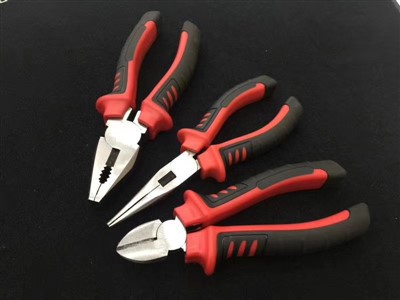
Long nose pliers (often called needle-nose pliers) are versatile hand tools for reaching into confined spaces, gripping small objects, bending wire, and performing intricate tasks.
Product Specifications
Length: Ranges widely from compact 5-inch (125mm) electronics models to heavy-duty 10-inch (250mm) or even 12-inch (300mm) versions for mechanics/electricians. Common sizes are 6-inch (150mm) and 8-inch (200mm).
Jaw Design:
Length & Taper: Jaws are significantly longer than standard pliers, tapering to a fine point (needle-nose) or a slightly broader tip (standard long nose).
Tip Width: The width at the very tip varies; needle-nose are extremely fine (<1mm), standard long nose are broader (1-3mm).
Serration: Most have fine cross-hatch serrations near the tip for positive gripping. Some have smooth jaws for delicate work or specialized serrations.
Alignment: High-quality pliers have precisely aligned jaws meeting flush along their entire length.
Cutters: Many long nose pliers have side cutters (diagonal cutters) near the pivot, enabling wire cutting without switching tools.
Material: Primarily made from high-carbon steel or chromium-vanadium (Cr-V) alloy steel. Cr-V offers superior strength, durability, and fatigue resistance.
Hardness: Jaws and cutters are hardened to high Rockwell C hardness (typically HRC 55-63) for wear resistance and cutting ability. The pivot area and handles are usually left softer for toughness.
Finish: Common finishes include:
Polished: Standard corrosion-resistant finish.
Satin/Nickel-Plated: Enhanced corrosion resistance and reduced glare.
Black Oxide/Oil Finish: Rust-inhibiting and non-reflective.
Handles:
Material: Bare steel, plastic-dipped (for comfort/grip), or dual-material (e.g., vinyl over steel).
Ergonomics: Contoured shapes reduce hand fatigue. Cushioned grips improve comfort and slip resistance.
Insulation: For electrical work, VDE/1000V insulated handles meeting strict international safety standards (e.g., IEC 60900, DIN EN 60900) are essential. These are typically bright orange/red or yellow and undergo rigorous dielectric testing.
Pivot: A hardened steel rivet or bolt provides smooth, precise action with minimal play or wobble. Some high-end models use adjustable tension systems.
Standards: Quality pliers often comply with international standards like DIN ISO 5746 (Pliers - Slip joint pliers and gripping pliers) or ANSI specifications.
Common Types
While all share the long jaw characteristic, variations exist:
Standard Long Nose: The classic design. Jaws taper gradually to a point. Often includes side cutters.
Needle Nose: Features extremely long, very fine-tipped jaws for accessing the tiniest spaces (e.g., jewelry, electronics, model making). May or may not include cutters.
Bent Nose (Right Angle/45 Degree): Jaws are bent at 45 or 90 degrees relative to the handles. Provides access to awkward angles or behind obstructions without repositioning the hand.
Manufacturing Process
High-quality long nose pliers are primarily manufactured using drop forging, ensuring strength and grain structure integrity:
Blanking: Steel bar stock (usually Cr-V alloy) is cut into short cylindrical blanks ("slugs") of the required weight.
Heating: Blanks are heated in a furnace to a precise forging temperature (typically 1100-1200°C / 2000-2200°F), making the metal malleable.
Drop Forging:
The hot blank is placed in the lower die cavity of a forging press or hammer.
The upper die is driven down with immense force (tons), pressing the blank into the shape of the pliers head (jaws and cutter area) and the rough handle profile. This aligns the metal grain for superior strength.
Trimming: Excess flash is trimmed off using a trimming press.
Jaws serrations, pivot hole & cutting edge is precisely made by CNC machines.
Heat Treatment:
Hardening: Plier heads are heated to a critical temperature and then rapidly quenched (cooled) in oil or polymer, transforming the steel microstructure to very hard martensite.
Tempering: Immediately after hardening, the pliers are reheated to a lower, specific temperature (e.g., 400-600°F / 200-315°C) and held. This reduces brittleness, increases toughness, and achieves the final desired hardness level. Different parts (jaw tips, cutters, pivot area) may undergo specific tempering.
Finishing:
Cleaning: Scale and residue are removed via shot blasting or chemical cleaning.
Machining: Jaws are precisely ground for perfect alignment and sharp cutting edges. Pivot holes are reamed. Surfaces are ground smooth.
Surface Treatment: Plating (nickel, chrome), polishing, black oxide coating, or oil finish is applied for corrosion resistance and appearance.
Handle Application: Plastic or vinyl grips are molded or dipped onto the handle arms. For insulated pliers, this involves specialized dual-material injection molding over the steel cores, followed by rigorous electrical testing.
Pivot Assembly & Testing: The two halves are aligned, a hardened steel rivet or bolt is inserted through the pivot hole, and the joint is peened or tightened.
Cutters are tested for sharpness, jaws for alignment and grip, and insulated handles for dielectric strength. Final inspection ensures quality.
Hot Tags: long nose bent nose plier, China long nose bent nose plier manufacturers, suppliers, factory, Adjustable Wrench, Allen Keys Hex Keys, Heavy Duty Double Ended Truck Wrench, impact socket set for lug nuts, Machinist Hammer, Sledge Hammer