


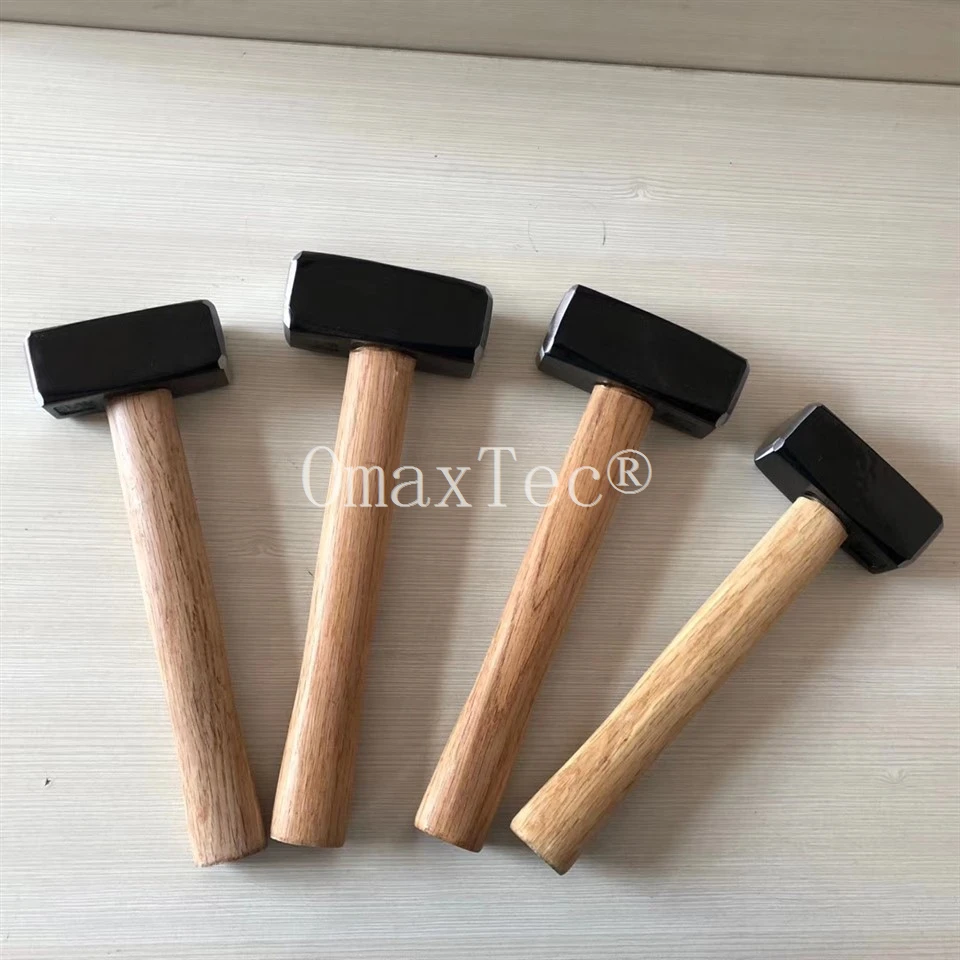


Stoning Hammer holds a crucial place, particularly for final finishing, deburring, and preparing surfaces for precise fits or visual inspection.
Product Specifications:
Head Design & Weight:
Typically features a double-ended head,
Common head weights range from 800 grams to 2500 grams. Weight selection depends on the material, stone size, and required pressure.
Ends are precision-machined to hold specific stone shapes securely. Common end types include:
Square Shank: For rectangular or square stones.
Round Shank: For cylindrical stones.
Handle:
Material: High-quality Hickory wood is traditional, prized for its shock absorption, strength, and feel. Modern alternatives include fiberglass composite (for extreme durability and moisture resistance) and ergonomic polymers (for vibration dampening and comfort).
Length: Typically ranges from 250mm (10") to 350mm (14"), balancing leverage and control. Shorter handles offer more finesse for intricate work; longer handles provide more power for larger surfaces.
Shape: Often features an ergonomic oval or contoured profile to fit the hand comfortably during prolonged use and reduce fatigue. A flared end prevents slipping.
Common Types of Stoning Hammers:
Standard Double-Ended Stoning Hammer: The most common type. Features two identical shanks (e.g., both square, both round) on either end of the head. Allows for quick switching between two stones of the same shape but potentially different grits.
Combination Stoning Hammer: Features different shank types on each end (e.g., one square, one round). Provides maximum versatility in a single tool, enabling the user to switch stone shapes without changing hammers.
Manufacturing Process:
Head Forging/Casting:
Forging (Preferred): High-quality alloy steel billets are heated and shaped under immense pressure in dies. Forging aligns the grain structure, resulting in superior strength, toughness, and impact resistance. This is the standard for professional-grade hammers.
Casting (Economical): Molten steel is poured into molds. While cheaper, cast heads are generally less strong and impact-resistant than forged ones, though suitable for lighter-duty applications.
Machining:
The forged or cast head blank undergoes precision machining (turning, milling, drilling).
The striking faces are ground flat and parallel.
The stone-holding shanks are machined to exact tolerances (square, round, slotted).
The eye (hole for the handle) is precisely bored and often tapered.
Heat Treatment:
The machined head undergoes hardening (heated to critical temperature and quenched) to achieve high surface hardness.
Followed by tempering (reheated to a lower, specific temperature and cooled). This crucial step reduces brittleness induced by hardening, restoring toughness and ductility to the core while maintaining surface hardness. Final hardness typically ranges from HRC 50-60.
Surface Finishing:
Heads are often shot-Blasted to induce compressive surface stresses, improving fatigue life.
Final grinding or polishing may be done on critical surfaces (e.g., shanks).
A protective finish (e.g., black oxide, phosphate coating, paint, or clear lacquer) is applied to prevent corrosion.
Handle Manufacturing:
Wood: Selected hickory blanks are cut, shaped (turned on a lathe for oval profile), sanded smooth, and sometimes treated with linseed oil or sealant. The end is shaped to fit the head's eye precisely.
Composite/Fiberglass: Resin-impregnated fiberglass strands are molded under heat and pressure into the desired handle shape and profile.
Polymer: Engineered polymers are injection-molded into ergonomic shapes, often with over-molded soft-grip areas.
Assembly:
The handle is securely fitted into the head's eye.
For wood handles, this traditionally involves driving a wooden wedge into the top of the handle end protruding through the eye, causing it to expand and lock tightly. Often supplemented with a steel cross wedge for extra security. Modern methods frequently use high-strength epoxy adhesives.
Composite and polymer handles may use adhesive bonding or be molded directly onto a metal tang extending from the head.
Quality Control & Testing:
Dimensional checks on head and handle.
Hardness testing of head faces and shanks.
Visual inspection for defects.
Impact and pull testing to ensure the head-handle connection integrity.
Final inspection and packaging.
Hot Tags: stoning hammer, China stoning hammer manufacturers, suppliers, factory, Adjustable Wrench, good impact sockets, Hand Axe, Rigid Heavy Duty Pipe Wrench, Swedish Pipe Wrench, Wrecking Bar Pry Bar


